The need for flexibility, independence from any single vendor, and meeting regulatory requirements means many companies now use multiple cloud platforms at once. But this freedom of choice comes with serious operational challenges.
Managing thousands of resources across public clouds and private data centers manually has become too difficult for DevOps teams. Cloud bills often exceed expectations, and the complexity of tracking connections in a distributed environment constantly creates risks for stable operations.
One of the most effective way to meet these challenges is to make artificial intelligence the central element for managing the entire infrastructure. Let’s look at how AI solves three key problems: management complexity, rising costs, and insufficient reliability.
How AI Creates a Single Source of Truth for Multi-Cloud
Managing separate cloud environments is like trying to conduct an orchestra where every musician plays their own tune. In this situation, AI becomes the conductor who synchronizes all the parts.
Unified Visibility
AI platforms collect metrics, logs, and configuration data from all sources into one unified dashboard. This creates a complete digital model of your hybrid infrastructure.
In practice, this means an SRE engineer doesn’t just see that an application has failed—they see the entire chain of causes. For example, it can show how a database slowdown in a public cloud is linked to increased network latency between different clouds. This approach cuts problem diagnosis time from hours to minutes.
AI-Powered Workload Placement: Deploying Smarter
Artificial intelligence actively participates in management. By analyzing a new application’s requirements — required performance, acceptable latency, legal restrictions, and budget — the system can automatically choose the best cloud environment for deployment.
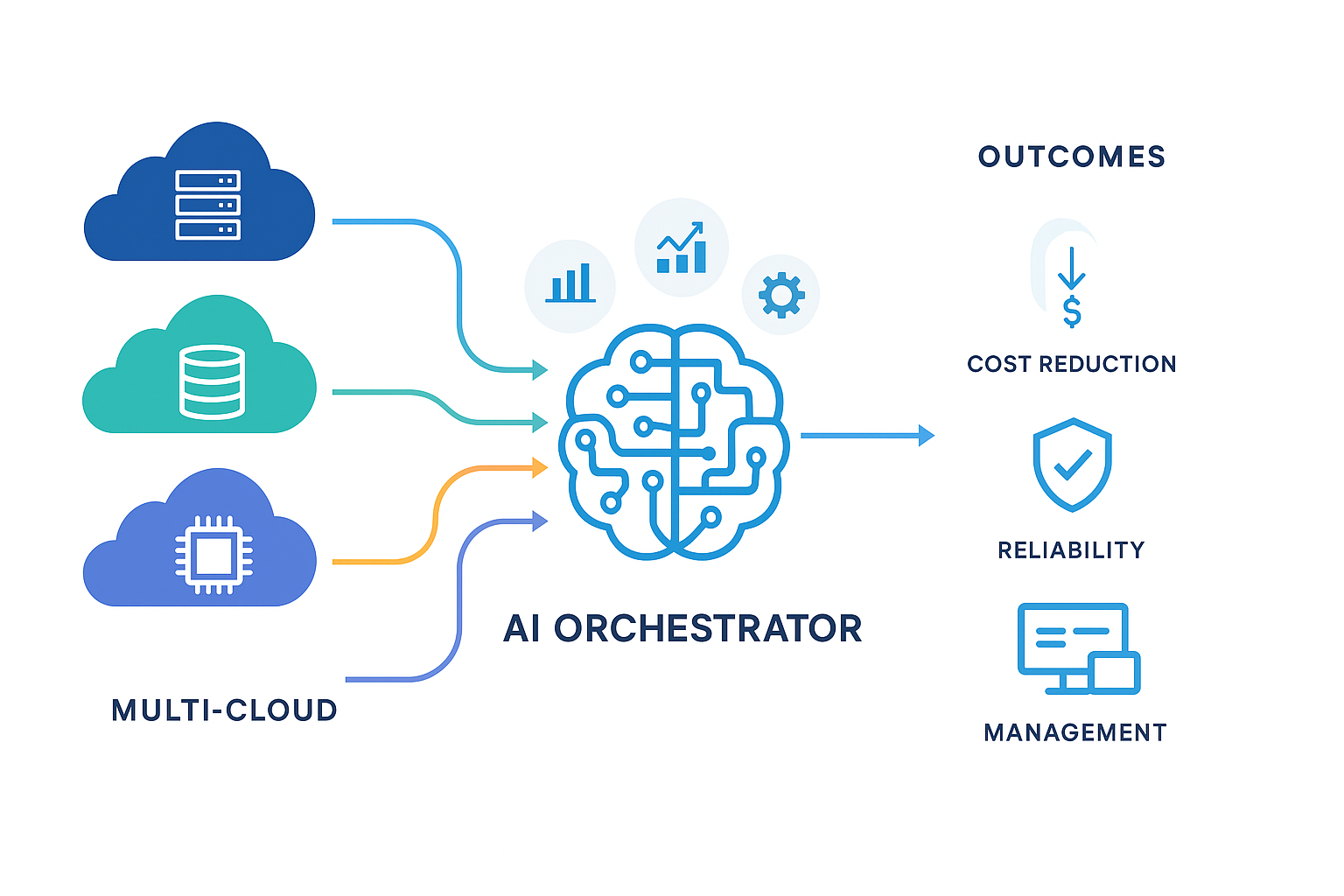
A Practical example: For a resource-intensive machine learning task, AI may choose a powerful GPU virtual machine in a public cloud. At the same time, it can automatically place a customer database, which must stay within the country, in a private cloud or with a local provider.
As a result, routine decisions that once required hours of meetings and table comparisons are now made automatically. The multi-cloud setup begins to work according to set business goals, not one-off technical instructions.
How AI Cuts Cloud Costs with Smart Automation
Financial optimization in a multi-cloud environment isn’t a one-time search for discounts. It’s a continuous process of fine-tuning that is practically impossible to do manually.
Right-Sizing Resources Automatically
Special services constantly analyze historical data on CPU, memory, and disk usage of virtual machines. Machine learning algorithms identify usage patterns and determine when a machine’s resources are constantly idle or insufficient.
Imagine a real situation. AI notices that an m5.xlarge virtual machine has used only 15% of its CPU and 30% of its memory for the last two months. The system suggests replacing it with a less powerful m5.large model. This simple change can cut costs by 50% without affecting the application’s performance.
AI for Smarter Budgeting and Reserved Instances
Buying reserved instances is an effective way to save, but it’s hard to predict which resources a business will need in the future. This is where AI helps.
The system analyzes historical usage patterns, seasonal business activity, and development plans. Based on this, it builds an accurate forecast of which reserved capacities to purchase from each cloud provider.
Vendor research indicates this approach can save up to 72% compared to pay-as-you-go pricing.
Additionally, AI can predict peak loads. Instead of reacting to a traffic surge that has already happened, the system prepares extra resources in advance before a major marketing campaign starts. This ensures uninterrupted operation during the peak and automatic savings after it ends.
Continuous Waste Detection: Finding Unused Resources
AI performs continuous infrastructure audits, automatically finding and marking unused but paid-for resources for deletion: "forgotten" virtual machines, disconnected disks, and unused IP addresses.
How AI Prevents Outages and Automates Recovery
Reliability in a modern digital environment isn’t just about creating backups. It’s the ability to anticipate problems and respond to them automatically.
Predictive Failure Analysis
By the time a person notices a problem, a server may already have stopped working. AI sees it approaching. By analyzing telemetry data, the system finds anomalies—for example, a slow but steady increase in database response time or more frequent disk read errors.
From practice, it’s known that machine learning-based monitoring platforms can warn of a high probability of a hard drive failure on a server within the next 48 hours. This allows engineers to calmly replace the disk during planned maintenance, completely avoiding unplanned downtime of an important application.
Automated Incident Response
AI doesn’t just warn — it acts. Automated scenarios are set up to trigger when certain incidents are detected.
In a typical scenario, if a web server fails a health check for more than 2 minutes, the system automatically takes it out of service, deletes the problematic instance, and deploys a new, working copy. The entire process happens without human involvement, reducing downtime from tens of minutes to a matter of seconds.
Orchestrating Disaster Recovery (DR)
In the event of a serious failure in one region or cloud, AI can automatically launch a pre-prepared disaster recovery plan. Modern systems can continuously run resilience tests by simulating minor failures. This helps check the environment’s stability and constantly improve recovery plans.
Conclusion: The AI-Powered Multi-Cloud Advantage
Without artificial intelligence, managing a multi-cloud environment today is a routine, expensive, and risky job. AI fundamentally changes the situation, turning it into an automated, economical, and predictable process.
In management, AI becomes the single control center that ties together disparate cloud environments. In financial matters, the system takes cost optimization to a new level, finding savings opportunities invisible to the human eye. For infrastructure reliability, AI enables a shift from simple stability to the ability to predict and independently fix problems.
Implementing artificial intelligence in cloud management is no longer a question of technological prestige. It is a practical necessity for any business that wants to develop confidently in the digital age. The necessary tools for this are already available, and a strategic multi-cloud approach lays the essential foundation for AI-driven success.